Nobody Made This Alone: The Wild, Messy World of Digital Art Collectives
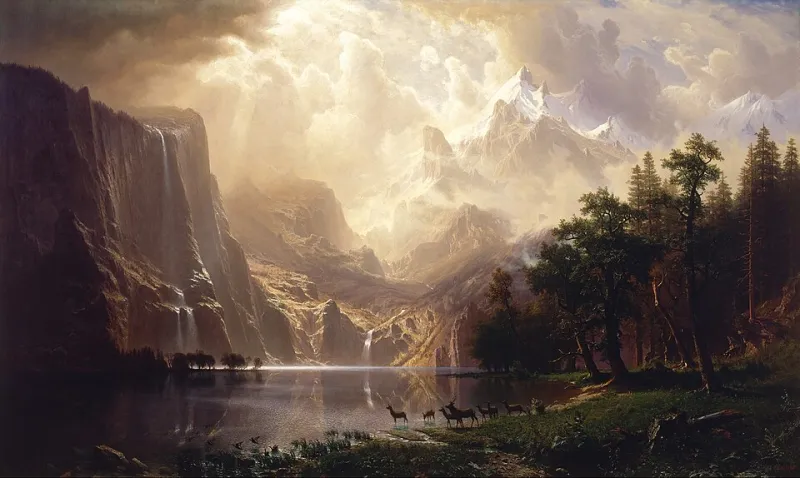
Photo: Albert Bierstadt, Public domain, via Wikimedia Commons
There's no single person to credit for some of the most interesting digital art circulating online right now. No solo visionary, no singular name to attach to the work. Instead, there's a Discord server with 400 members across twelve time zones, a shared folder full of half-finished files, and a release date nobody technically agreed to but somehow everyone honored. Welcome to the collective.
Digital art collectives — decentralized, often anonymous, sometimes chaotic creative groups operating across platforms — are producing work that's pushing experimental boundaries in ways solo artists rarely can. They're building game mods, releasing generative art series, running collaborative animation projects, and experimenting with authorship itself as a creative concept. And they're doing it largely outside the structures of traditional art institutions.
The Infrastructure of Organized Chaos
If you picture a traditional creative studio, you probably imagine hierarchy: a director, a team, clear roles, defined deliverables. Digital art collectives tend to operate on something closer to controlled anarchy. Decisions get made through polls, arguments, gut feelings, and occasionally just whoever happened to be online at 2 a.m. when the deadline hit.
The tools are scrappy but effective. Discord is the backbone for most active collectives — it's free, persistent, and flexible enough to run everything from critique sessions to version-control debates. From there, groups branch out: shared Google Drives for assets, GitHub for code-based projects, Figma for collaborative visual work, and increasingly, blockchain-based platforms for releasing and attributing work.
One collective operating under the name Null Assembly — a group of about thirty artists scattered across the US, Canada, and Europe — described their process as "productive misunderstanding." In a public post on their community forum, they wrote: "Half the best work we've made started because someone misread a brief and went in a completely different direction. We stopped correcting people and started asking what they were actually seeing instead."
The Authorship Question
Here's where things get genuinely interesting — and a little legally murky. When forty people contribute to a single piece, who made it? Traditional copyright law isn't particularly well-equipped for this question. Most collectives handle it through informal agreements, shared pseudonyms, or by releasing work under Creative Commons licenses that sidestep individual ownership entirely.
The NFT space forced some of these conversations into sharper focus. When collective work gets minted and sold, the question of who receives funds, how credit is distributed, and what happens when members leave becomes suddenly concrete. Some collectives dissolved over exactly these disputes. Others used the tension productively, building transparent revenue-sharing structures and publishing their internal governance docs as part of the work itself.
LA-based collective Peripheral Forms — known for their generative video pieces that blend machine learning with hand-drawn elements — released their entire creative process as an open-source repository. The artwork and the methodology behind it became one inseparable package. "We wanted the process to be the thing," one member explained in an interview with an experimental art newsletter. "The finished piece is almost secondary."
Anonymity as Creative Tool
A significant number of active collectives operate with partial or full anonymity. Members use handles, avatars, and pseudonyms. Nobody knows who lives where, what their day job is, or what their art school credentials look like — because most of them don't have art school credentials. The work gets evaluated on its own terms.
This strips away a lot of the social dynamics that can calcify traditional creative environments. Nobody's pulling rank based on a prestigious MFA. Nobody's deferring to someone because they have more Instagram followers. The work either lands or it doesn't, and the critique tends to be blunter for it.
It also creates space for experimentation that professional reputations might otherwise constrain. A designer who works corporate gigs during the week can take genuinely weird risks under a collective banner that they'd never attach to their professional portfolio. Anonymity becomes a kind of creative freedom.
Where Gaming and Art Blur
Some of the most experimental collective work happening right now isn't in galleries or NFT marketplaces — it's in game modification communities. Mod collectives for games like Minecraft, Skyrim, and various indie titles have produced work that functions as genuine artistic statements: total conversions that reimagine the source material as something unrecognizable, experimental spaces built purely for visual exploration, narrative mods that push into genuinely literary territory.
The gaming context adds a layer that pure digital art often lacks: interactivity. When a collective builds a mod that turns a first-person shooter into a meditative walking experience through procedurally generated landscapes, the audience doesn't just look at the work — they move through it. That changes the relationship between creator and viewer in ways that are still being figured out.
Collective Drift Protocol, active primarily in the Half-Life 2 modding community, spent eighteen months building an environmental art piece disguised as a level pack. Players who downloaded it expecting additional gameplay found themselves in abstract architectural spaces with no objectives, no enemies, and a slowly shifting ambient soundtrack. Reviews were mixed. Downloads were massive.
The Distributed Creative Future
What's emerging from the collective model isn't just a different way to make art — it's a different set of assumptions about what art is for. When authorship is distributed, when process is public, when the community that makes the work and the community that consumes it are sometimes the same people, the boundaries that traditional art structures rely on start to feel pretty arbitrary.
That's uncomfortable for some institutions and exciting for a lot of practitioners. The experimental edge of digital art right now lives less in individual studios and more in these messy, decentralized, hard-to-categorize online spaces where nobody's waiting for permission to release something.
The work coming out of these collectives isn't always polished. It's sometimes contradictory, occasionally baffling, and frequently impossible to fully attribute. But it's alive in a way that a lot of carefully produced, individually credited work simply isn't.
Maybe that's the point. Maybe the chaos is the feature.