These 5 Games Broke Storytelling on Purpose — and It Was Glorious
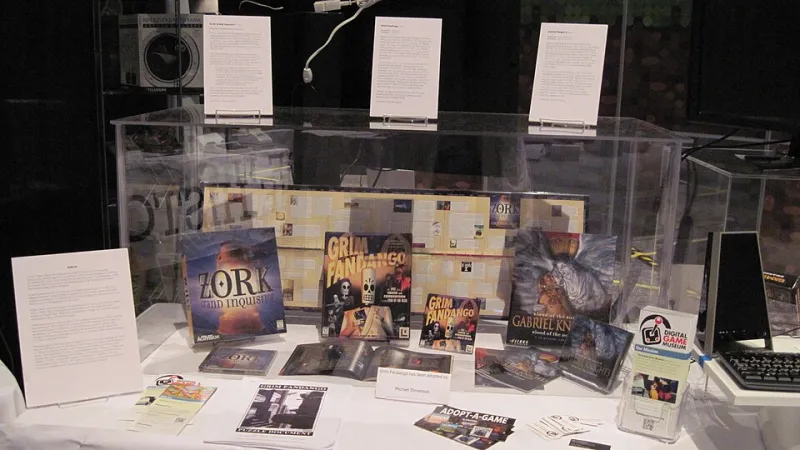
Photo: Digital Game Museum, CC BY 2.0, via Wikimedia Commons
Most games tell you a story. A good chunk of them tell you a pretty great one. But every once in a while, something comes along that doesn't just tell a story — it dismantles the idea of what a story in a game is supposed to be, hands you the pieces, and watches what you do with them.
These are those games. Not all of them were massive commercial hits. Some of them made people genuinely uncomfortable. A few of them broke the internet in the best possible way — not through spectacle, but through the kind of design choices that make you put the controller down and just think for a minute.
Here are five experimental interactive narratives that redefined player agency, each in a completely different way.
1. Disco Elysium — The Game That Made Failure Interesting
Let's start with the one that probably has the biggest cultural footprint on this list. When Disco Elysium dropped in 2019 (with its full voice-acted Final Cut following in 2021), it landed like a genuinely alien object in the gaming landscape.
On the surface: a detective RPG. In reality: a sprawling, politically charged, deeply weird meditation on ideology, memory, and self-destruction, set in a city that feels like it was designed by someone who read too much Dostoevsky and not enough sleep.
What made it experimental wasn't just the writing — though the writing is extraordinary. It was the skill system. Your character's internal voices (Inland Empire, Electrochemistry, Shivers, and dozens more) are all playable characters in their own right, arguing with each other and with you, offering interpretations of the world that are sometimes useful and sometimes completely unhinged. You can fail skill checks in ways that generate entirely new narrative possibilities. The game doesn't punish failure — it feeds on it.
For players used to games that reward optimization, Disco Elysium was a shock. For players who wanted something that actually had something to say, it was a revelation.
2. Immortality — When the Archive Becomes the Puzzle
Sam Barlow has been doing weird, interesting things with interactive narrative for a while now (Her Story, Telling Lies), but Immortality from 2022 is where his approach got genuinely avant-garde.
The premise: three films starring actress Marissa Marcel, none of which were ever released. Your job is to scrub through archival footage — raw takes, behind-the-scenes material, screen tests — to figure out what happened to her.
But Immortality isn't really about solving a mystery. It's about the act of watching itself. The way the game lets you pause on a frame and match-cut to another piece of footage featuring the same object or gesture creates a genuinely hypnotic, almost essay-film quality. The narrative that emerges is fragmented, disturbing, and deeply concerned with questions of image, identity, and what movies do to the people who make them.
Some players found it maddening. Others called it one of the most important interactive works ever made. Both groups are kind of right.
3. Kentucky Route Zero — Magical Realism as Mechanic
If you asked someone to describe Kentucky Route Zero to a person who'd never played it, they'd probably struggle. It's a point-and-click adventure game. It's also a meditation on debt, loss, and the American heartland. It's also magic realism. It's also structured around the idea that your choices don't change the plot — they change who you are while the plot happens.
Developed by Cardboard Computer and released episodically between 2013 and 2020, KRZ takes place in a mythical underground highway beneath Kentucky. The characters you meet are strange, the dialogue is sometimes more poetry than conversation, and the game frequently breaks form in ways that feel genuinely theatrical — at one point, the entire game becomes a stage play, with you controlling the spotlight.
The big swing here is that player agency isn't about outcomes. You're not choosing what happens. You're choosing how your characters understand and articulate what happens. It's a subtle, strange distinction, and it produces an experience that feels completely unlike anything else in the medium.
4. Undertale — The Game That Remembered You Were Playing a Game
Okay, yes, you've heard of Undertale. But its place on this list isn't about nostalgia — it's about the specific way Toby Fox used meta-awareness as a storytelling tool in a way that still hasn't been fully replicated.
The game's most infamous route — the genocide run, where you kill every monster in the underground — doesn't just make you feel bad in the abstract. It engineers the feeling. The music slows down. Encounters become tedious. The game's most likable character breaks the fourth wall to tell you, directly, that you're doing something wrong. And the consequences of completing that route persist across save files in ways the game doesn't explain.
What Undertale understood is that player agency is only meaningful when the game takes your choices seriously — not just narratively, but mechanically and emotionally. The genocide route is punishing because it's supposed to be. You chose this. The game remembers.
For 2015, that was a genuinely radical design statement.
5. We. The Revolution — Moral Weight Without a Safety Net
Less discussed than the others on this list, but worth your time: We. The Revolution is a strategy/narrative game set during the French Revolution in which you play a judge of the Revolutionary Tribunal. Every day, you sentence people to death or acquittal. The game gives you incomplete information, political pressures from multiple factions, and a family at home whose safety depends on your continued influence.
There are no good choices. There are only choices with different costs. The game's refusal to offer a moral framework — to tell you who the bad guys are — is its central design statement. It trusts (or maybe forces) you to sit with genuine discomfort in a way that most narrative games carefully avoid.
It's not a perfect game. But as an experiment in what moral agency actually feels like when it has real weight, it's one of the most interesting things to come out of the indie space in years.
What These Games Actually Have in Common
Look across these five and a pattern emerges: none of them are trying to be movies. None of them are trying to be novels. They're using the specific properties of interactive media — player agency, mechanical systems, the relationship between the person holding the controller and the world on the screen — to do things that no other medium can.
That's what experimental game design looks like when it's working. Not games that are hard to play, but games that are genuinely hard to leave behind.