Machines as Muses: Inside the Studios Where AI and Artists Actually Work Together
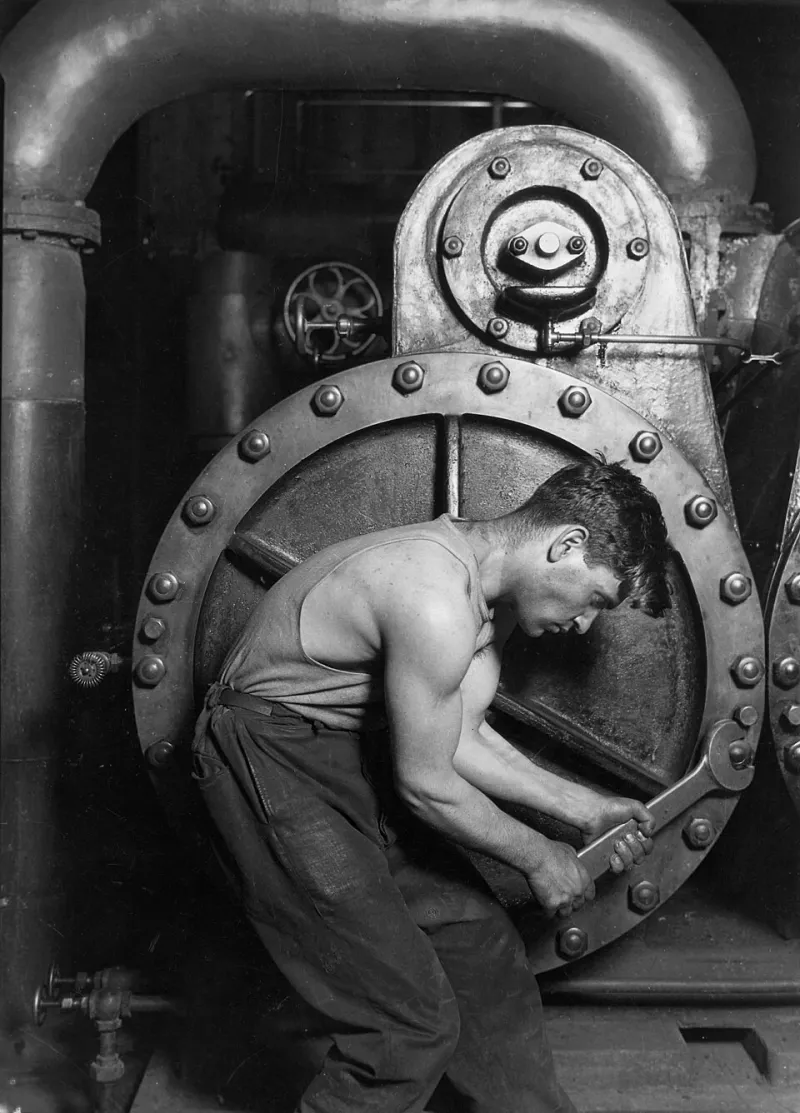
Photo: Lewis Hine, Public domain, via Wikimedia Commons
There's a moment that digital artist Nadia Osei describes as the one that changed everything for her practice. She'd been feeding fragmented diary entries, half-remembered dream notes, and color palette references into a generative model she'd been training for weeks. What came back wasn't what she expected — and that, she says, was exactly the point.
"It gave me something I would never have made myself," she told us over a video call from her studio in Brooklyn. "Not because it was better or worse. Because it was other. And that otherness is where the real work starts."
That tension between expectation and surprise sits at the heart of a growing movement in digital art — one that's quietly reshaping how we think about creativity, authorship, and what it even means to make something original in 2024.
Beyond the Hype Cycle
Let's be honest: the conversation around AI-generated art has been kind of exhausting. Twitter arguments about whether Midjourney images "count," think pieces about the death of the illustrator, stock photo companies quietly panicking — it's been a lot. But zoom out from the noise, and something genuinely fascinating is happening in the spaces where serious artists are actually experimenting.
Collectives like Obvious (yes, the ones behind that $432,500 Christie's sale back in 2018 that started the whole debate) have evolved far beyond their early work. More interesting right now are smaller, weirder operations — groups of artists, coders, and sometimes musicians who are building workflows where the line between human intent and machine output gets deliberately blurry.
Take the LA-based collective known as Softcopy. Their ongoing project, Residue, involves feeding archival footage from demolished Los Angeles neighborhoods into a custom diffusion model, then having human artists respond to the outputs with traditional illustration and sound design. The final pieces are layered, haunting things — part documentation, part fiction, part something that doesn't have a clean category yet. The AI isn't making the art. But it's not just a tool either. It's more like a collaborator with genuinely alien aesthetics.
The Workflow Nobody Talks About
Here's what most coverage of AI art misses: the actual process is slow. Like, genuinely painstaking. Artists working seriously with generative models spend enormous amounts of time on training data curation, prompt engineering, post-processing, and the kind of iterative refinement that looks a lot like, well, traditional artistic practice.
New York-based artist and coder Marcus Tran runs a one-person studio where he builds what he calls "reactive portraits" — AI-generated images that shift and evolve in response to real-time social media sentiment data pulled from specific communities. Getting the model to behave in ways that feel intentional rather than random took him the better part of a year.
"People see the output and think it just... happened," he says. "But there are thousands of decisions baked into every image. Which data sources I chose, how I weighted them, what aesthetic references I trained on, how I intervene when the model goes somewhere I don't want it to go. That's all me. The machine is fast and strange, but it's not directing anything."
This is the part of the conversation that tends to get lost when people argue about whether AI art is "real" art. Authorship in these workflows isn't absent — it's distributed, layered, and sometimes genuinely collaborative in ways that are hard to map onto traditional models of creative credit.
The Authenticity Question (And Why It's Complicated)
Okay, so here's the philosophical bit. Does it matter if a human made something, if the human's fingerprints are all over the process but not necessarily on every pixel?
There are serious thinkers on multiple sides of this. Some argue that art's value is inseparable from the lived human experience that produces it — that a machine, however sophisticated, is shuffling and recombining without genuine feeling or intention. Others point out that this argument could have been (and was) made about photography, about digital illustration software, about sampling in music.
What's interesting is that many of the artists working most seriously in this space aren't particularly interested in resolving the debate. They're more focused on what the collaboration makes possible — aesthetic territories that neither a pure human practice nor a pure generative system could access alone.
Osei puts it this way: "I'm not trying to prove anything about AI. I'm trying to make work that affects people. If the process involves a model that does things I couldn't predict, that's not a problem. That's the whole reason I'm here."
Collectives Rewriting the Rules
Beyond individual studios, there's a collective energy building around AI-assisted art that feels genuinely new. Online spaces — certain corners of Discord, experimental platforms like are.na — are hosting ongoing conversations between artists who are sharing training datasets, custom models, and workflow experiments in ways that look more like open-source software culture than traditional art world gatekeeping.
The collective Gradient Dreams, operating mostly anonymously out of various US cities, has been releasing a series of "open score" projects — shared AI models that any artist can use to generate source material, with the collective curating and exhibiting responses from contributors worldwide. The resulting shows are chaotic, inconsistent, and sometimes genuinely stunning. They're also basically impossible to attribute in any conventional sense.
That's either a problem or a feature, depending on your perspective. For Gradient Dreams, it's clearly the latter.
So, Are Humans Still Necessary?
Short answer: yes, obviously — but maybe not in the ways we assumed.
The artists and collectives doing the most interesting work in this space aren't trying to automate creativity. They're using AI to break their own habits, to generate material they couldn't have consciously designed, and to ask questions about process and authorship that feel genuinely urgent in 2024.
The machine doesn't have intent. It doesn't have something to say. What it has is an extraordinary capacity to surprise — and in the right hands, that surprise is exactly the raw material that human creativity needs to do something real with.
Whether the art world catches up to that understanding is a different question. But in studios from Brooklyn to LA, the experiment is very much ongoing — and the results are worth paying attention to.