Hold Music, Ambient Loops, and 2 A.M. Headphones: The Quiet Rise of Audio Art
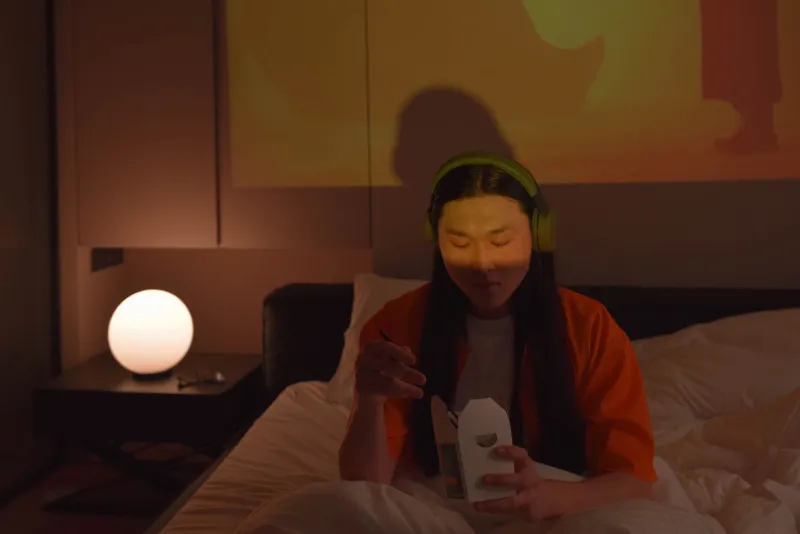
There's a moment — usually around 2 a.m., phone face-down on the nightstand, one earbud in — when a piece of sound stops being background and starts being a place. Maybe it's a generative drone that never quite repeats itself. Maybe it's a loop of rain on a Detroit porch that someone spliced into something stranger. You didn't seek it out like a gallery show. It just arrived, through an app, a podcast tail, a YouTube video titled something like "the sound of an empty mall in 1994."
That arrival is not an accident. It's the work of a growing crew of artists who treat audio the way their peers treat pixels: as raw material for installations, experiments, and experiences designed to be lived in rather than listened to.
The Gallery You Can't Screenshot
Visual digital art has an obvious problem: it's everywhere, it's scrollable, and it competes with about ten thousand other images for your attention. Sound works differently. You can't skim it. You're inside it the moment it starts.
That's the pitch a lot of audio artists make, even if they'd never phrase it that pretentiously. A generative soundscape — the kind built in tools like Max/MSP, Pure Data, or increasingly with AI-assisted composition systems — doesn't have a beginning or an end in any meaningful sense. It has weather. It shifts. It might run for eight hours and never play the same bar twice.
Some of these artists come out of ambient music traditions — the long shadow of Brian Eno looms over everything — but they're not making records. They're making environments. A track that resolves and ends is a song. A piece that dissolves when you stop paying attention is closer to architecture.
The Hold Music Caper
The funniest and most telling corner of this scene is the artists who plant their work in places nobody would ever call art. One musician we spoke with — a Portland-based composer who asked to go by her handle, since her day job is very much not this — spent a year submitting generative compositions to be used as corporate hold music through third-party audio licensing services.
"Nobody's listening to hold music critically," she says. "It's the most hostile listening environment on Earth. You're annoyed, you're on mute, you're waiting for a rep named Chad. If a piece of mine can make that moment 4% more bearable, that's a more successful installation than most gallery shows I've done."
She's only half joking. The point underneath the bit is real: audio art doesn't need a white cube, or even a URL of its own. It can live inside the plumbing of everyday apps — the meditation app whose background drones are actually a commissioned generative system, the indie game whose menus hum with a soundscape that subtly responds to your save file, the podcast whose outro music is a different generative variation every single week.
Built for the 2 A.M. Session
Then there's the work that's openly, unapologetically designed for the insomniac economy. Scroll any streaming platform late at night and you'll find hour-long uploads with titles like "a warm room far from here" — often from artists with modest followings and fiercely loyal listeners.
These aren't sleep playlists. The best of them are composed, sometimes algorithmically, to reward attention without demanding it. A slowly evolving drone might surface a melody once every twenty minutes. A field recording of a distant highway might be pitch-shifted so gradually you never notice it changed. Listeners describe these pieces the way people describe a favorite room: specific, personal, theirs.
The comment sections under these uploads read like notes left in a shared apartment. "Been falling asleep to this for 400 nights." "Played this during my move from Chicago to Denver and now it smells like cardboard to me." You don't get that under a digital painting.
Why the Ear Is the Last Untamed Canvas
Here's the argument the audio artists keep making: vision got colonized. Every visual format — the image, the GIF, the video, the filter — has been optimized, monetized, and compressed into the feed. The ear never got the same treatment. Podcasts came close, but podcasts are talk, not texture.
That leaves open space. Sound art can be experimental in ways that would look gimmicky if you could see it. A piece that's literally just a room tone, slowly detuning over six hours, is unmarketable as an image and weirdly compelling as an experience. There's no thumbnail. There's no scroll-stopping. There's just you, consenting to be somewhere for a while.
It's also, conveniently, cheap to make and nearly impossible to steal in a satisfying way. You can right-click-save an image; you can't right-click-save a generative system running live in someone's custom app.
Where This Goes Next
The smart money says audio art follows the same arc visual digital art already did: first dismissed as wallpaper, then discovered by collectors, then argued about at length in publications exactly like this one. Interactive sound installations are already showing up in museum lobbies and pop-up spaces in LA and Brooklyn. Spatial audio — the tech behind your fancy headphones' head-tracking — is giving artists a genuine new canvas: sound that sits in a specific place around you and waits.
But honestly, the most interesting work will probably stay small. A loop nobody owns. A hold music heist. A drone that only exists between 1 and 4 a.m. because the artist scheduled the stream that way on purpose.
The feed taught us to look at everything. The next wave of artists is betting we've forgotten how to listen. They're not yelling to get our attention. They're just quietly occupying the one channel we can't close.
So tonight, somewhere between the last push notification and the first one, maybe put something on that wasn't made to be finished. Let it run. See if the room changes.