Made for the Scroll: The Artists Who Treat TikTok Like a Gallery Wall
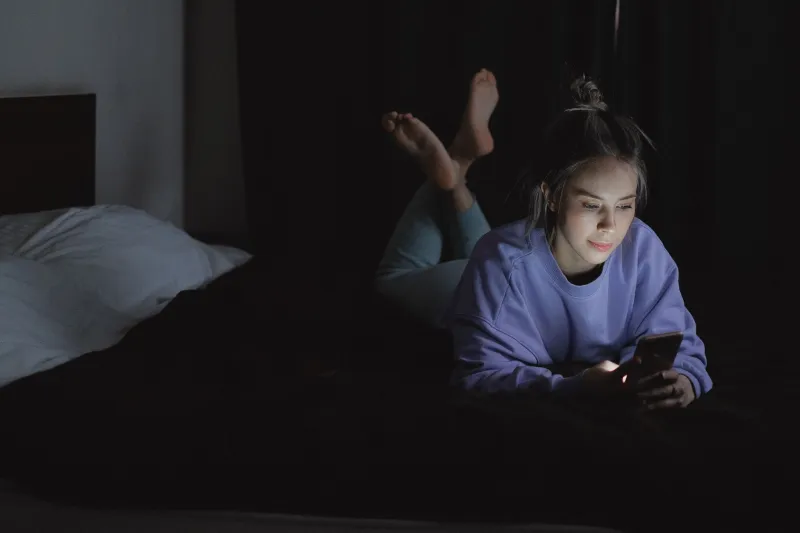
There's a moment every scroller knows. You're three videos deep into a 2 a.m. session when something stops your thumb — a loop so seamless you watch it twice before realizing you've been had. That moment, the accidental pause inside an infinite scroll, is where a growing community of artists has decided to live.
They're not posting digital art to TikTok or Instagram. They're making work that could not exist anywhere else — pieces shaped by compression artifacts, autoplay, the tyranny of 9:16, and the strange intimacy of watching art on the same screen where you check your bank account.
The Constraint Is the Point
Ask a painter about their materials and they'll talk canvas and pigment. Ask Maya Ortiz, a 26-year-old motion designer in Chicago who goes by @softstatic online, and she'll talk bitrate.
"TikTok's compression is brutal," she says. "Fine gradients turn to mush. So I stopped fighting it. Now I design gradients that only look right after the platform chews them up. The upload is part of my process, not the end of it."
Ortiz's pieces — hypnotic, color-saturated loops that ripple and dissolve — are built to survive the platform's re-encoding. She exports, uploads, downloads her own video, studies the damage, then goes back in. Sometimes three or four rounds. It's darkroom thinking for the algorithm age: the machine develops the photo, and the artist reacts.
This is the throughline connecting these creators. Where earlier generations of digital artists saw platform limitations as obstacles to route around, this crowd sees them as studio materials. Autoplay means every piece needs a cold open that works mid-scroll. The vertical frame means composition is about the center third, because that's where the UI captions live. Sound-off viewing means text and motion carry the narrative.
Every constraint is a design brief.
Loops That Lie
Los Angeles filmmaker Devon Park calls his TikTok-native shorts "feed films" — 20 to 40 second vertical narratives engineered to be watched out of order, mid-scroll, possibly muted.
"Cinema assumes attention," Park says. "The feed assumes you're already leaving. So I make films that reward the person who stays and don't punish the person who goes." His best-known piece, a looping vignette of a man repeatedly missing a bus that slowly reveals itself to be the same bus from different decades, has been viewed north of 12 million times. Most of those views lasted under eight seconds. Park is fine with that.
"Eight seconds is a real runtime," he laughs. "Hitchcock didn't have to compete with a guy eating a 12-ounce ribeye. I do."
Then there's the opposite impulse: art built to degrade. A loose network of creators, most of them in their twenties and scattered across the US and Europe, makes work explicitly designed to fall apart through reposting. Screenshots of screenshots. Re-uploads that lose sync between audio and image until the piece becomes something new — a corrupted cover version the original artist never made but fully endorses.
"It's erosion as distribution," says one Berlin-based creator who asked to go by their handle, nullwave. "A painting doesn't change when it's photographed. My work does. The repost is the second act."
The Algorithm as Collaborator
Here's where things get philosophically messy. For a decade, creators have framed the algorithm as an adversary — a black box to be gamed, appeased, or cursed. The artists in this scene have mostly made peace with it, and some have gone further.
Ortiz describes her process as a "call and response" with the recommendation system. She posts variations of a piece, watches which ones the feed picks up, and lets that feedback shape the next iteration. "It's not that different from testing a mix on different speakers," she says. "The room is part of the music."
Park is more skeptical but pragmatic. He doesn't chase trends, but he does pay attention to when his work surfaces — often months after posting, resuscitated by whatever the platform decides is newly relevant. "The feed has a memory that nobody understands, including the people who built it," he says. "That's kind of beautiful, honestly. Your work can come back from the dead on a Tuesday."
Critics, of course, have a ready objection: isn't this just making ads for yourself? The artists push back hard. Their argument is that every medium arrived with baggage. Painters accepted the rectangle. Filmmakers accepted the cut. The vertical feed, the loop, the compression artifact — these are simply the formal conditions of now. Ignoring them, they argue, is what would make the work dishonest.
Small Screens, Serious Stakes
What's striking is how seriously the art world is starting to take this. A handful of US galleries and university programs — from coastal MFA programs to Midwest new-media festivals — have begun exhibiting feed-native work on phones mounted at eye level, rather than blowing it up onto walls where it doesn't belong. The piece is shown on a cracked iPhone with the notification bar visible, because that's the work.
Whether this moment lasts is an open question. Platforms change, formats die, and an art form welded to a specific app's quirks is welded to that app's survival. But the artists aren't worried.
"Vine died and the loop survived," Park says. "MySpace died and the top-eight survived. The medium migrates. The instinct to make something small and strange for a stranger's screen — that's not going anywhere."
He's probably right. Somewhere tonight, a thumb is pausing on a nine-second loop it doesn't understand yet, and an artist is counting that pause as a job well done.