Done Is Overrated: Why the Sketch Is Beating the Masterpiece
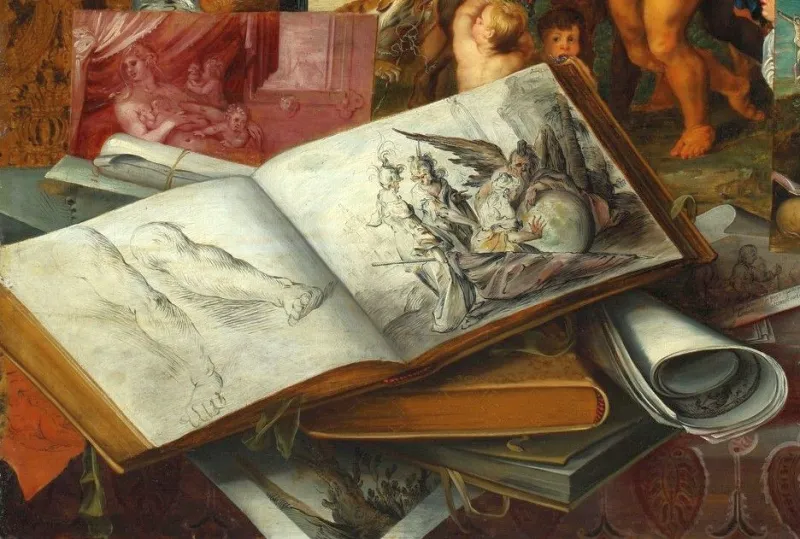
Photo: Étienne de La Hire, Public domain, via Wikimedia Commons
There's a folder on almost every digital artist's hard drive that never gets opened in public. It's full of half-rendered compositions, abandoned color studies, three-second loops that never became anything, and audio experiments that got shelved before they had a name. For most of art history, that folder was private by definition — the mess behind the curtain. But something's shifting. Increasingly, that folder is the work.
The Unfinished Piece as a Statement
It started quietly. A few visual artists posting work-in-progress files with captions that weren't teasing a final reveal — they were just... stopping there. No "full version dropping soon." No "stay tuned." The sketch was the post. The process document was the exhibition.
What followed wasn't confusion. It was connection.
Audiences responded to incomplete work with a kind of engagement that polished, finalized pieces rarely generate. Comments weren't "when's the full version out?" — they were "this is exactly what I needed to see." The rawness hit different. And artists noticed.
This isn't just a vibe shift. Critics and curators are starting to take it seriously too. Several digital galleries in New York and Los Angeles have hosted shows explicitly centered on unresolved work — pieces presented in "draft" states, complete with visible layer structures, alternate color versions, and notes about why the project stalled. The framing isn't apologetic. It's intentional.
Music Production and the Forever-Beta Album
Music might be where this trend cuts deepest. The traditional album cycle — record, master, release, promote, done — is getting quietly dismantled by a generation of producers who grew up on SoundCloud, where uploading an unfinished beat at 2 a.m. was just normal behavior.
Some artists are now releasing what they're calling "living projects" — albums or EPs that exist in permanent beta. Tracks get revised after release. Mixes change. Lyrics evolve. The version you heard six months ago isn't the version that exists today. There's no definitive edition, and that's the whole point.
This approach frustrates streaming platforms, which prefer clean, static metadata. It makes playlist curation awkward. It breaks the standard promotional machine. And none of that seems to bother the artists doing it — if anything, the friction is part of the appeal. The work resists being packaged, which means it also resists being consumed and discarded.
Why Audiences Are Hungry for Process
Here's the honest reason this is resonating: people are exhausted by perfection.
The internet has spent the last decade training us to expect finished surfaces everywhere. Feeds are curated. Profiles are managed. Even "casual" content is strategically constructed. In that environment, stumbling across something genuinely unresolved — a piece that clearly doesn't know what it wants to be yet — feels almost startling. It feels real.
There's also something democratic about process-forward art. A polished final piece holds the viewer at arm's length. It's complete without you. But a sketch, a beta, a work-in-progress invites you into a conversation that hasn't ended. You can see where decisions were made. You can imagine alternate paths. You become, in a small way, a participant rather than just a consumer.
Psychologically, this taps into something researchers call "the IKEA effect" — the tendency to assign more value to things we've had a hand in building, even partially. Watching a piece develop, following an artist through their uncertainty, gives audiences a sense of ownership over the outcome. That emotional investment doesn't come from a finished canvas.
The Critical Conversation Catching Up
For a while, the art criticism establishment was slow to engage with this. "Unfinished" still carried a whiff of excuse — a way to dodge judgment by never fully committing. But that read is becoming harder to sustain.
Writers and critics are now drawing parallels to earlier movements: the Abstract Expressionists who elevated gesture over composition, the Fluxus artists who made the event more important than any object it produced, the punk ethos of releasing music that technically "shouldn't" be out yet. Incompleteness has a lineage. What's new is the scale at which it's happening and the digital infrastructure that makes sharing unfinished work frictionless.
The conversation is also bumping up against questions about authenticity that feel particularly urgent in 2024. When AI can generate a convincing "finished" piece in seconds, the hand-hewn roughness of a human process document becomes almost a proof of origin. The imperfection is the signature.
What This Means for How We Value Art
If the sketch starts mattering more than the final piece, a lot of assumptions get scrambled. Gallery pricing, for one — how do you value something that isn't done? Archiving becomes complicated. Intellectual property questions get weird when a "living project" keeps changing after it's been licensed or sold.
But maybe those complications are worth sitting with. The idea that art has a completion date — a moment when it stops being made and starts being owned — was always a bit of a commercial fiction. Work doesn't stop meaning things just because someone decided it was finished.
What digital artists are doing right now, whether they'd frame it this way or not, is pushing back on that fiction. They're insisting that the making is inseparable from the made thing. That the value lives in the movement, not the stillness.
And honestly? In a media landscape full of immaculate, algorithm-optimized content, a little stillness-free honesty sounds like exactly what the feed needs.